

FOREWORD
While this new writing project of mine seems like a departure from my usual brand of horror, it does combine two other timeless interests of mine: monsters and Sailor Moon. And if we look past the shōjo surface of that iconic 1990s anime, there are moments of horror from time to time. This aspect, however, only exists on account of the villains; the Dark Kingdom, the Black Moon, the Death Busters, the Dead Moon, and Shadow Galactica all embody the sheer darkness of Sailor Moon’s surreal universe. And usually, the antagonists demonstrated their badness by unleashing bizarre and grotesque monsters upon the world.
Now, the objective of this column is straightforward; I shine a light on the many creatures who served as brief obstacles for the heroes of Sailor Moon. Why would I do that, you might ask. Well, even though there is a decent amount of writing and analysis for the major villains in the anime, their minions don’t quite enjoy the same attention. Even merchandisers don’t seem too interested in them, either. Yet as someone who sees “monster of the week” as a draw rather than a weakness, naturally I would want to write about this anime’s wealth of freaky, amusing, and sometimes unsettling subordinates.
MORGA
モルガ · Moruga
“I’m not your mother!”
– Morga to Naru
As fans know, the Sailor Moon manga didn’t use the monster-of-the-week format anywhere as much as its first anime counterpart. In fact, once the core Sailor Senshi were all found and gathered in the manga’s inaugural story arc, the Dark Kingdom’s underlings, collectively called Yōma (妖魔), were phased out altogether. Even so, those initial adventures featured one of the more ghastly monsters to be born from creator Naoko Takeuchi’s fervent imagination.
WHEN AND WHERE
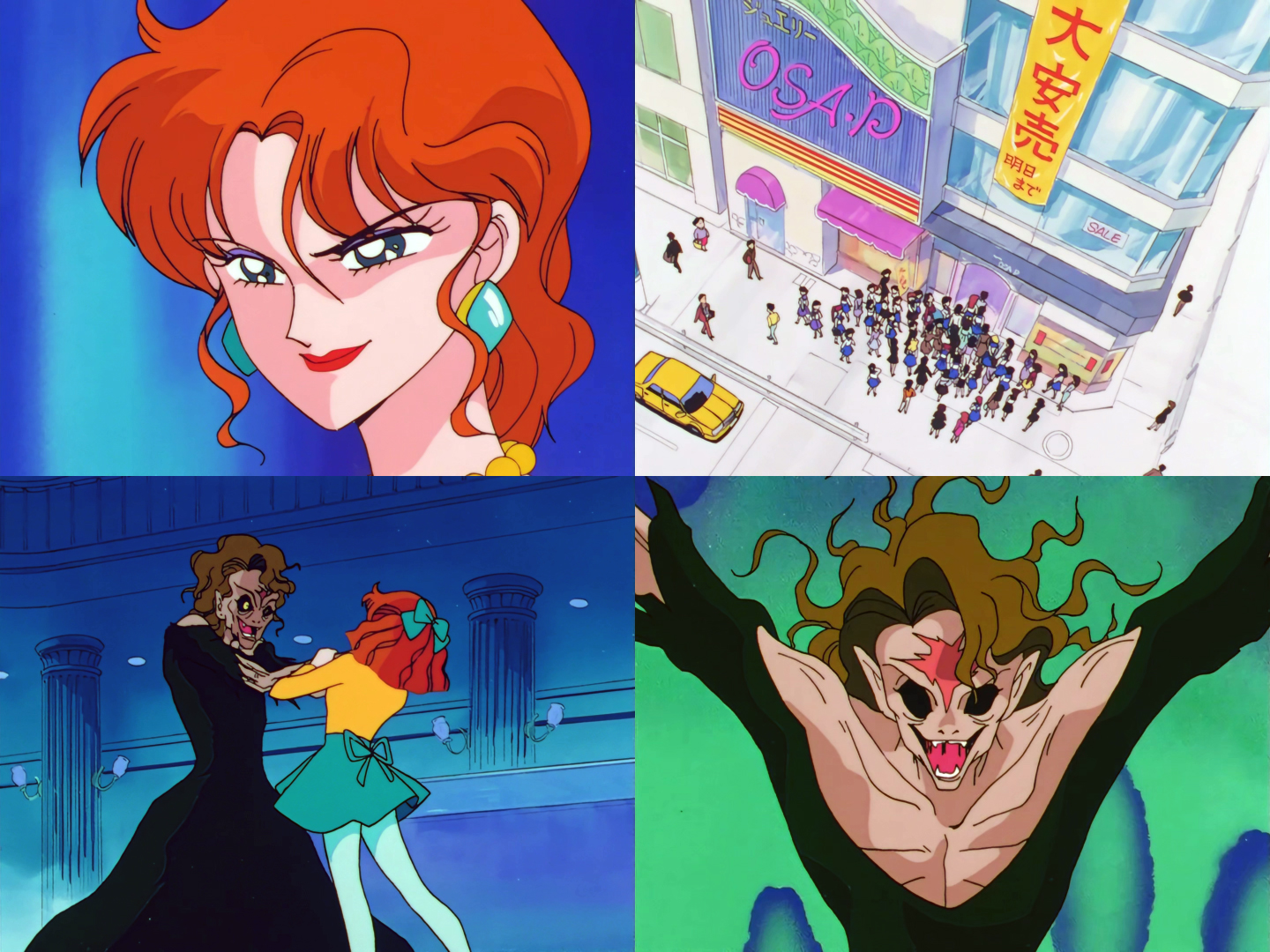
In the premiere episode of the classic anime, The Crybaby: Usagi’s Beautiful Transformation, the Dark Kingdom has commenced its plan to conquer present-day Earth, with Azabu-Jūban, Tokyo being its main target. The first of the four Dark Kingdom emissaries, Shitennō Jadeite, sends his servant, the Yōma Morga, to collect life energy from the patrons of Jewelry OSA·P. There, Morga disguises herself as the shop’s owner, Naru Osaka’s mother, before eventually revealing her true form and intentions.
ETYMOLOGY
Morga was one of two Yōma from the manga to cross over to the small screen (twice now with the inclusion of Sailor Moon Crystal). Unlike the manga, though, the ’90s anime actually referred to her by name, one later used in a recap of the first manga. Nevertheless, that otherwise lack of identification for the monsters only further emphasized their disposability in the source material.
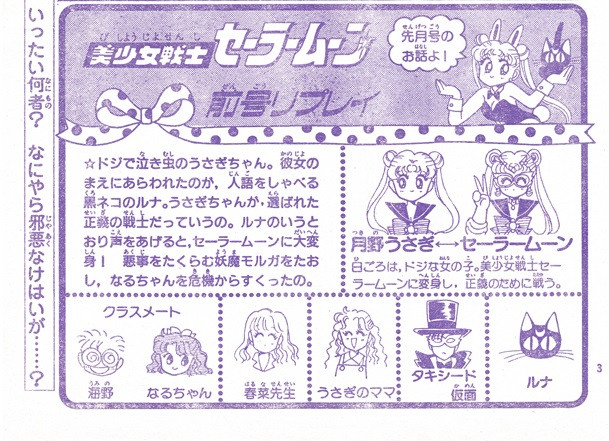
SailorFunComics has the most sound reasoning behind Morga’s name; she, like other villains, is named after a mineral or stone. In this case, a type of beryl called morganite is Morga’s namesake.
Morga’s name sounding like the Japanese loanword for a morgue — morugu (モルグ) — is, perhaps, pure coincidence. Another chance connection: Tuxedo Unmasked pointed out how the “ga” in her name could be in reference to the Japanese word “gashi” (餓死, starvation). This makes sense, from a fan’s perspective, when considering Morga’s gaunt appearance, not to mention a line about Naru’s mother being starved to death in the manga.
DESIGN

While Takeuchi ultimately didn’t play a big role in the original anime adaptation, be it the story or the characters, she did help design several of the early Yōma. Needless to say, the show’s staff went in a different direction, seeing as Takeuchi’s own take on Sailor Moon’s first anime adversary looks more like Queen Beryl. The sketch for the anime’s second-ever Yōma, Balm, is closer to Morga’s finalized look than what she proposed.
As an aside, this wouldn’t be the last time the mangaka got involved in the monster-making; Takeuchi also created the ’93 Super Famicom game’s three original Yōma.
The definitive Morga design is comparatively simple when remembering what all followed her, specifically those wackier Dark Kingdom creatures seen after Nephrite’s departure. The flowing black gown is rendered lifeless due to its wearer’s cadaverous frame, and her visage and physique are each so zombie-like and withered, thoughts of death instinctively come to mind. Morga gives off the semblance of a once-elegant woman who is now no more than a demonic husk. It comes an no surprise as to why she still creeps out fans, all these years later.
THE BATTLE

Despite her glaring inexperience, Sailor Moon still bested Morga in the end. However, that victory was more influenced by sheer luck than any actual skill, apart from a rather good first use of Moon Tiara Action. In addition to Tuxedo Mask’s impeccable timing, Sailor Moon displayed a rarely used power — the inexplicable Supersonic Waves emitted from her odango jewels — that we only see once more, later on in SuperS. Funnily enough, the first Nakayoshi Anime Album lists “high frequencies” (高周波, kōshūha) as Morga’s weakness. The logical question upon reading that bit of obviousness: Was that vulnerability always existent or only mentioned after the fact?
From controlling Jewelry OSA·P’s customers like a bokor, to manipulating her body like a preternatural contortionist, this well-powered Yōma put up a good fight. And had great fortune not been on Sailor Moon’s side that fateful day, Morga would have succeeded.
EPILOGUE
By the time Sailor Moon first started airing (March of 1992), Japan’s economic bubble had burst. This period is referred to as the Lost Decade, and depending on the source, the end date varies. The anime doesn’t directly reflect that then-reality, however, the sudden fever for bargain-priced yet fine jewelry seems appropriate, given the troubling times ahead. Neither Jadeite nor Morga go into the reasoning behind their jewelry scheme, but maybe they were more aware of Japan’s financial crisis than they let on. This act of enemies manifesting human phenomena or problems as tangible monsters would only become more conspicuous as the series continued.
As previously mentioned, this episode is one of the few to be directly based on a manga act. And considering Takeuchi’s love of jewelry, the choice of setting is, most likely, not that thematically significant.
The 1990s anime had struggled with tone — should it be more funny or more serious? — before easing up in some respects. One regretful choice was the diminishing of the Yōma, who once stood as fierce and frightful enforcers. Morga led this pack of particular Yōma that were not walking motifs or blatant nods to the anime’s tokusatsu inspirations. No, she was one of the precious few monsters who was plain nightmarish and severe. There was no joking around as Morga threatened to kill Naru and her mother, and then came dangerously close to snuffing out Sailor Moon. Not a great deal of monsters in the series ever got that close to such sheer ferocity. 🌙

 Tales from the Paulside
Leave a comment