
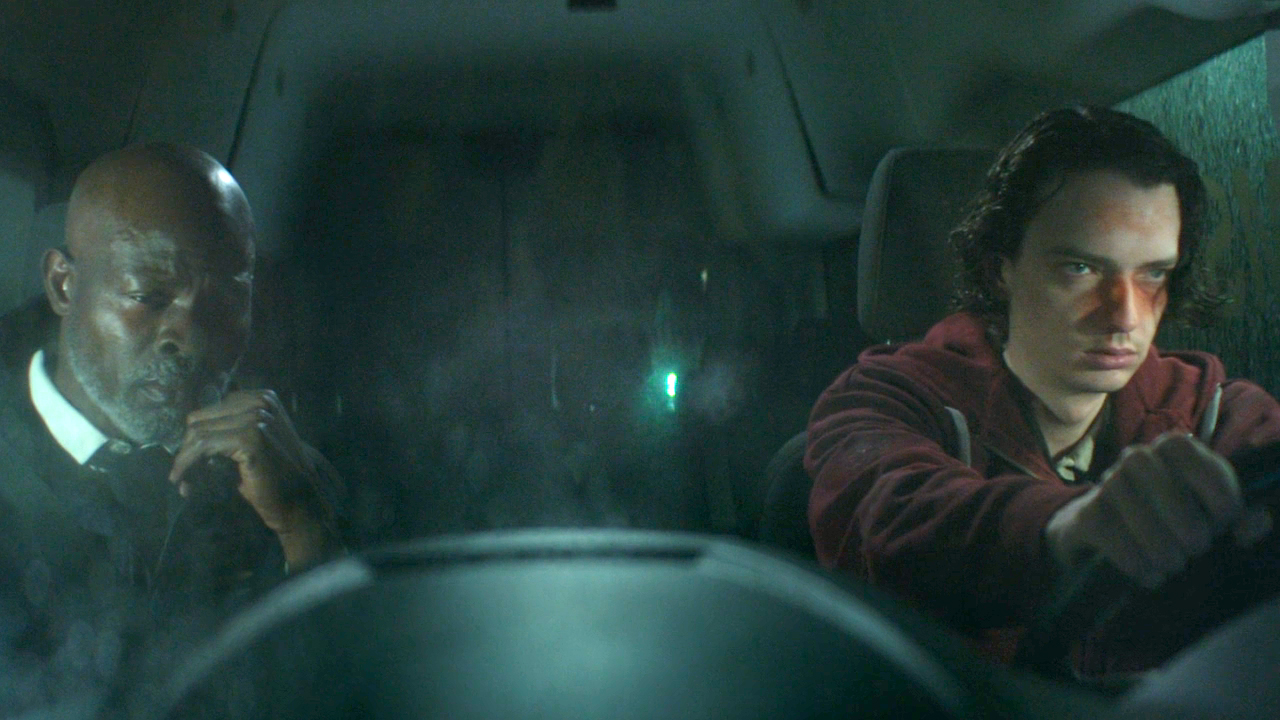
As accurate as its title is, The Passenger surely would have benefitted from being called something else. As a result of its current name, the movie is bound to get lost in the shuffle. Especially when there’s already another thriller of the same name, one that’s barely a few years old; and a horror movie called Passenger was released into theaters just last month. Nevertheless, Vadim Perelman‘s thriller shouldn’t go unseen, particularly if you prefer your thrillers to be more confined and, for the most part, limited to two characters.
Perelman, who gave us the profound (yet depressing) House of Sand and Fog, focuses on another immigrant family that has been trying to make it in America. Sadly, it seems as if little has changed in twenty-three years; xenophobia and racism are as rampant now as they were back in 2003. But The Passenger is about as subtle as Perelman’s debut; on top of that potent dose of frothing bigotry contained to one scene, there is that familiar kind of prejudice lurking in the background. From the moment Djimon Hounsou‘s Somalia-born character, an airport driver named Hassan, picks up a distressed, white 27-year-old named Lloyd (Kodi Smit-McPhee), you can feel something insidious in the works. That bad feeling only exacerbates as Hassan then agrees to illegally shuttle Lloyd all the way to Chicago.
That “something’s not right here” feeling soon proves true, as the airport Hassan and Lloyd just left is attacked. It’s a blip of a scene where one tertiary character is caught off guard in what looks like a massive explosion. A terrorist attack. Apart from this moment, Perelman and writer Bennett Fisher‘s movie doesn’t return to the scene of the crime, but rather stays on its co-leads as they journey into the night. In something of a twist, however, both are ignorant as to what’s befallen the airport.
From there, and upon learning the truth, Hassan and Lloyd engage in a back-and-forth dialogue (both directionally and dialogically) that’s mostly contained to the shuttle van. The performances here are each convincing; Hounsou is true to his feelings and never falters, whereas Smit-McPhee plays the sort of radical who’s not completely convinced of their beliefs and actions. The latter feels more authentic, as far as young, modern terrorists go. It’s not the cold, resolute attitude you’ve come to expect of bombers in cinema; the lack of certainty, along with the vulnerability, that Smit-McPhee gets across is, in its own way, as affecting as that of Hounsou’s struggling, financially desperate character. The movie, thankfully, doesn’t have a change of heart, and it doesn’t expect you to have one as well. Hassan isn’t untouched by his captor’s actions and words, but he never flips his script in a way that undoes his own foundation.
This whole movie isn’t set inside Hassan’s van, and there are other characters, but the best moments are those between Hounsou and Smit-McPhee. They snare your attention, and they stay intriguing. Even when they seem to say everything about themselves, there is still more to learn and unpack. It’s a matter of wanting more than being outright unsatisfied. In that way, The Passenger is very much like real life.
The Passenger is now available for purchase/rental at digital outlets.


Leave a comment