
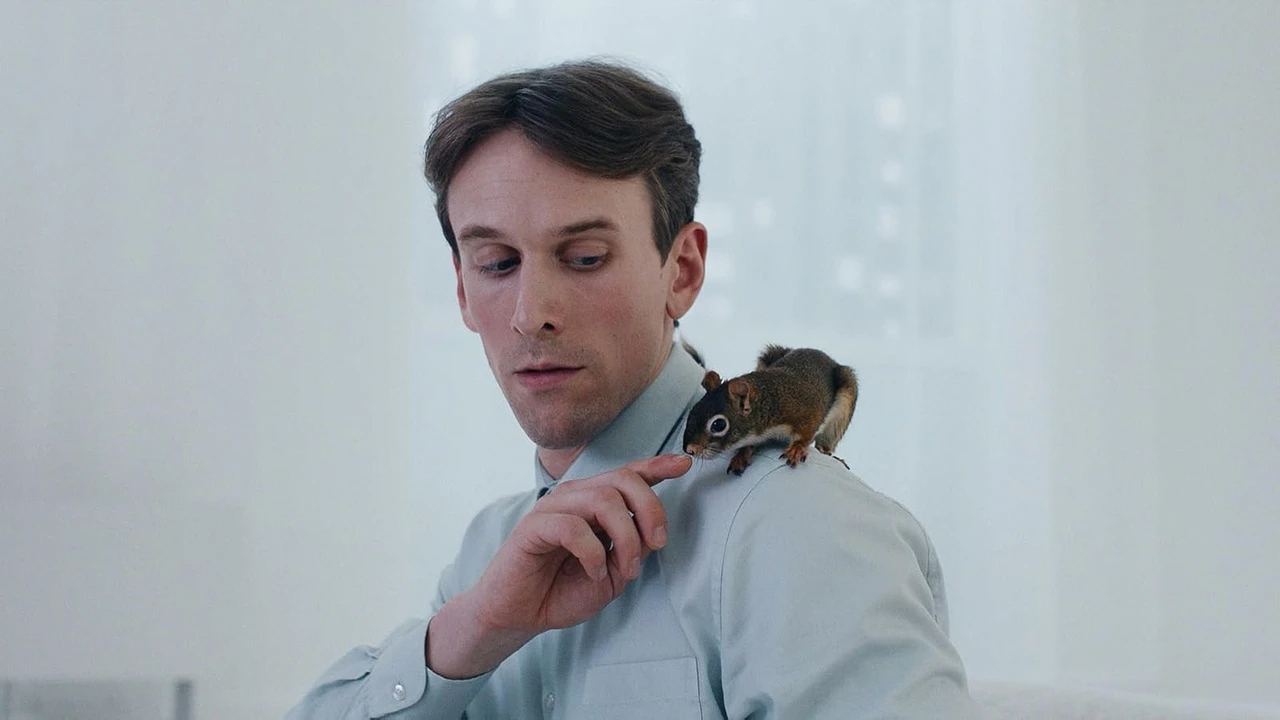
Squirrels don’t really register all that much for the average person. These cute but common creatures come and go during your lunch break outside? That’s fine. You see one scurry up a tree as you walk by? Also fine. Perhaps the only time a lot of us give squirrels any lingering thought is when they nearly cause a car accident.
In Markus Lehmusruusu‘s movie The Squirrel (or Orava in Finnish), those bushy-tailed tree dwellers don’t cross many people’s minds, either. Yet unlike those of us who fail to acknowledge them in our daily lives, the squirrels in this movie simply don’t exist. At least not anymore.
Utopia equals dystopia in The Squirrel. As we soon see, even a well-run, near-future society featuring little to no dysfunction isn’t problem-free. Smart and omnipresent technology has made individual thinking virtually unnecessary, and active risk aversion has made life utterly boring. And animal lovers? Sorry, but there are no critters in this world. Hence the need for people like Pasi (Miro Lopperi), those members of society who provide the closest thing possible to a dog or cat: robots.
Dystopian sci-fi movies, especially as of late, often entail an excess of overt grimness. More realistically, The Squirrel shows how we make our own societal downfalls without the need for war, disasters or zombies. In quite the opposite, Lehmusruusu’s world seems ideal. Everything is clean, order is maintained, and people’s basic needs are all met. At the same time, though, this sterile way of life leads to ennui. Removing what makes humans human—passion, curiosity, pleasure—does them a disservice in the long run.
Then enters the movie’s namesake. The aforementioned Pasi, an otherwise unremarkable robo-pet engineer, gets a much-needed spike of endorphins upon his taking care of a surviving squirrel. What was thought to have gone the way of the dodo is now here, in the middle of this cold and concrete paradise, and it’s dying. Similar to how humans would be better off with everything that’s been filtered out of them, so as to ensure a smoothly run society, this squirrel needs more than just its fundamentals to live.
Lehmusruusu paints a future that’s not unlike the one we’re headed for, and that in itself could be a bit alarming. The bleakness is, however, mitigated with a calming blue aesthetic, as well as some welcome moments of dry (and wet) humor. Mimosa Willamo is Emilia, the security employee who pukes at the sight or thought of physical intimacy, and she herself must overcome what’s all been strained from her being. And her doing so is rather funny.
Keep in mind, The Squirrel doesn’t agonize over itself. Realizations are more quiet than expected. This movie is what you order when you’re craving a more optimistic delivery of dystopian dread. Indeed, the story is about as subtle as your stubbing a toe, but in these certain times, delicacy isn’t always the best route.
The Squirrel screened at Fantastic Fest 2026.


Leave a comment